
Basement Mold Remediation
Basements are the default foundation across Westerville and Central Ohio, which makes basement mold one of the most common calls restoration professionals in this market take — not an occasional exception.
In much of the country, a flooded or musty basement is a niche problem. In Westerville and the rest of Franklin and Delaware Counties, it's close to the opposite. Central Ohio's clay soils, freeze-thaw winters, and a frost line deep enough that footers already have to sit well below grade all push local construction toward full poured concrete basements as the default, not the exception — which means basement mold is a standard-case situation restoration professionals see regularly, not an unusual one.
That basement-heavy housing stock also means sump pumps are standard equipment in most local homes, and sump pump failure during a heavy storm or power outage is one of the most common ways a basement ends up wet in the first place. Add foundation seepage through aging concrete, window-well leaks, and condensation that builds up on cool basement walls during humid summer months, and you have several distinct paths that all lead to the same result: mold on framing, drywall, or stored belongings below grade.
This page covers what basement mold remediation actually involves in a market where basements are the norm — from an unfinished mechanical room around a sump pit to a fully finished basement that took on water during a storm.
Why Basements Are Ohio's Most Common Mold Risk
A basement combines several conditions that favor mold growth: it's below grade, it's often less ventilated than the rest of the house, and it's in direct contact with soil that holds moisture long after a storm has passed. When a sump pump fails during a power outage — a scenario that comes up often during Central Ohio's spring and summer storm season — water can sit against framing and subfloor for hours before anyone notices, especially if the basement isn't used daily.
Freeze-thaw cycling adds a slower-moving version of the same risk. Repeated freezing and thawing stresses foundation walls over years, and hairline cracks that develop from that stress become a route for water seepage during heavy rain, even in a basement that's never had an obvious flood.
Where Basement Mold Typically Shows Up
Basement mold doesn't always start where it's easiest to see.
- Sill plates and framing where the foundation meets the wood structure above
- Poured concrete or block walls, especially around rim joists and window wells
- The area immediately around a sump pit or liner
- Ductwork and mechanical equipment located in the basement
- Drywall, carpet, and carpet padding in finished basements after a slow or unnoticed leak
- Cardboard boxes and stored belongings pushed up against exterior walls
What Basement Mold Remediation Typically Involves
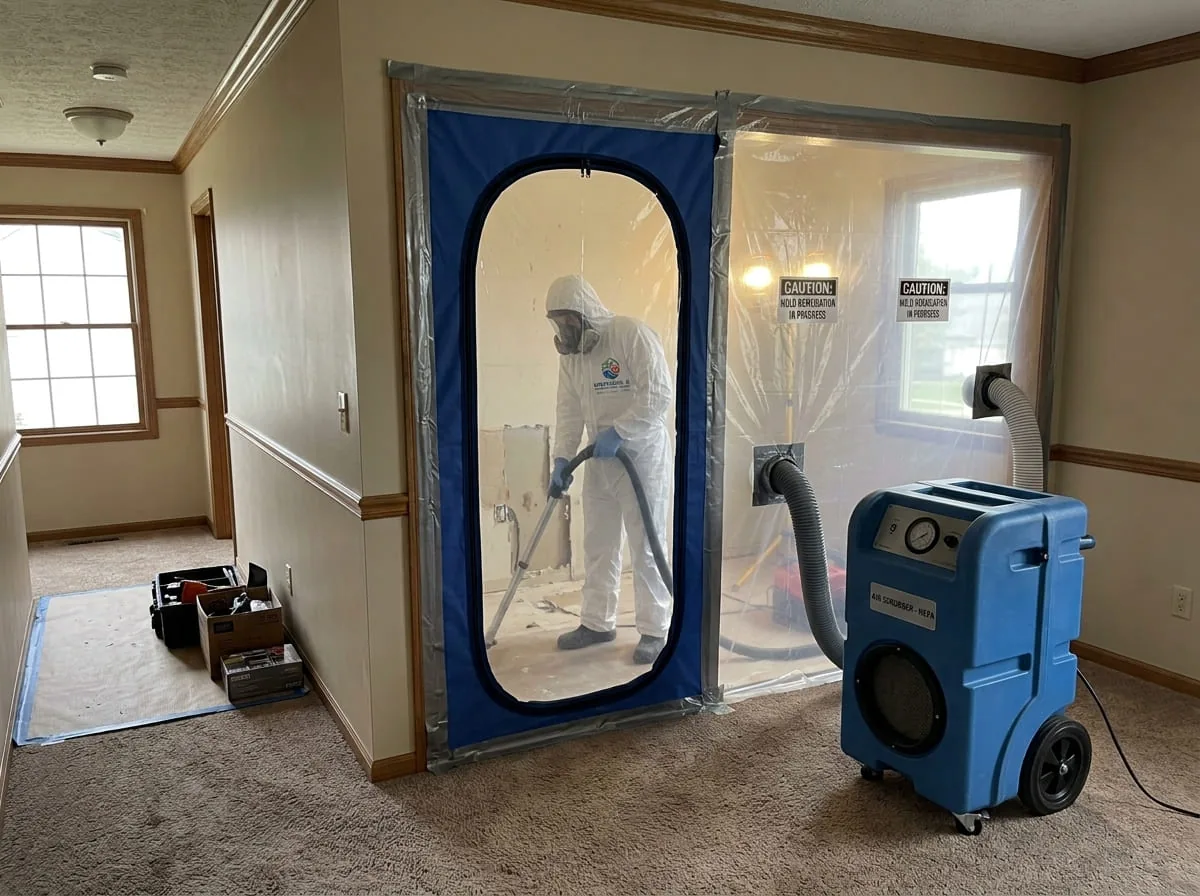
The process usually starts with an inspection to identify both the moisture source and how far the growth has actually spread, since basement mold is often more extensive behind finished walls or under carpet padding than what's visible at first glance. From there, the affected area is typically contained — with poly barriers and negative air pressure — to keep spores from moving up through stairwells or shared ductwork into the rest of the home.
Materials that absorbed moisture and can't be reliably cleaned, such as saturated drywall, insulation, or carpet padding, are generally removed rather than treated in place. Remaining structural surfaces — framing, subfloor, concrete — are cleaned and treated, and commercial dehumidification equipment brings the space down to a safe moisture level before any rebuild work starts. If the basement flooded as part of a larger water loss, this remediation work is usually coordinated with the extraction and drying process rather than treated as a separate job.
Finished Basements Carry Extra Risk
A finished basement adds a layer of risk that an unfinished mechanical room doesn't have: drywall, framing, and flooring can trap moisture out of sight for weeks after a minor leak or a period of high humidity, with no visible sign beyond a musty smell. Any finished basement that's had even a minor water intrusion — a small window-well leak, a sump pump that ran but briefly overflowed, condensation buildup during a humid stretch — is worth having checked behind the walls rather than assumed fine because nothing looks wrong on the surface.
It's also worth separating remediation from prevention. Restoration work addresses the mold and the materials it's growing on; an ongoing moisture source like a foundation crack or a chronically undersized sump pump may need a separate repair or waterproofing referral to keep the same problem from coming back.
Frequently Asked Questions
Why does my basement keep getting mold even after I clean it myself?
Repeated mold after cleaning usually means the underlying moisture source — a sump pump issue, a foundation crack, or ongoing condensation — hasn't been addressed, so surface cleaning is treating the symptom rather than the cause. A professional inspection can identify what's actually feeding the growth.
Is a musty smell in my basement just normal for an older Central Ohio home?
A musty odor isn't something to write off as normal, even in an older basement. It usually indicates moisture or mold somewhere in the space, sometimes behind finished walls where it isn't visible, and it's worth having inspected rather than assumed to just be an old-house smell.
Can I clean a small mold spot on unfinished basement concrete myself?
A small, isolated spot on bare, unfinished concrete can sometimes be cleaned with a basic household cleaner. If it keeps coming back, covers a broad area, sits near ductwork, or shows up on a porous material like wood framing or drywall, it's a job for a professional rather than repeated DIY cleaning.
Does a sump pump failure always lead to mold?
Not if the water is extracted and the area is dried quickly and thoroughly. The risk climbs the longer water sits, and Central Ohio's humid summer conditions can bring mold into play within 24 to 48 hours, so how fast the basement gets addressed after a sump pump failure matters more than almost any other factor.
Dealing With a Wet or Musty Basement?
Get connected with a restoration specialist who handles basement mold regularly in this market, from a sump pit to a fully finished lower level.
Request Water Damage Service