
Basement Water Damage & Flooded Basement Cleanup in Westerville, OH
Poured concrete basements are the standard foundation across Westerville and the surrounding Franklin and Delaware County suburbs, which makes basement flooding the single most common water-loss pattern in this market, not a rare exception.
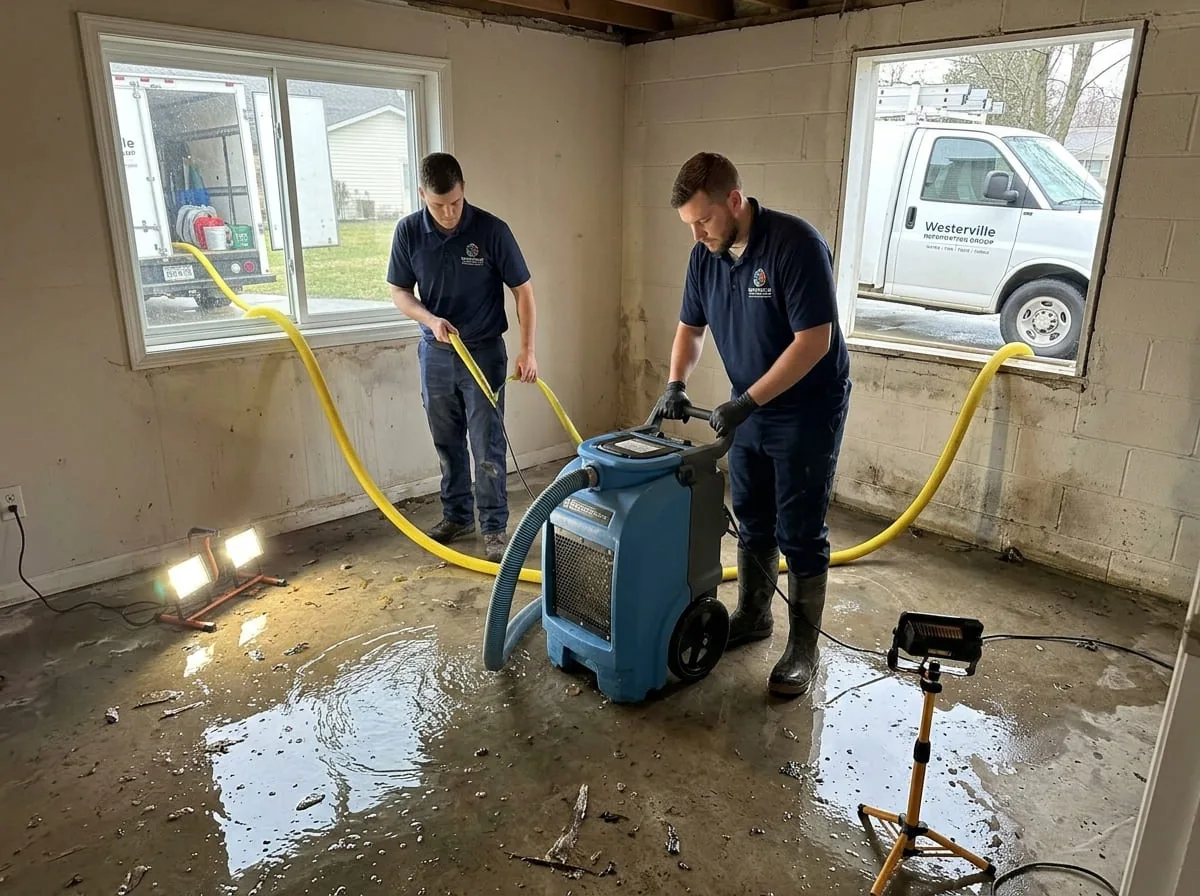
Ask around Westerville, Genoa Township, or Orange Township about water damage and basements come up almost immediately, and for good reason. Regional foundation contractors consistently describe a poured concrete basement as the most popular foundation choice for Ohio homes, driven by the state's clay soils, hard freeze-thaw winters, and a frost line that already requires footers to sit well below grade, so once a foundation is being excavated that deep, a full basement becomes the practical default rather than the exception. Crawl space and slab construction both exist here, in some newer subdivisions and on tighter lots, but they're the minority condition, not the norm.
That basement-heavy housing stock comes with sump pumps as a standard feature rather than an upgrade, and a specific set of flooding patterns that show up far more often here than in slab-on-grade markets: sump pump failure, foundation seepage through basement walls, window-well leaks during heavy rain, and the difference between a quick mop-up in an unfinished basement versus a genuine restoration job in a finished one. This page covers all four in real depth, because on this site, basement flooding isn't a niche add-on, it's the standard case.
Sump Pump Failure: The Most Common Cause
Sump pump failure during heavy rain or a power outage is one of the most frequent basement-flooding causes reported by homeowners across the Westerville market, and it tends to happen for a small number of predictable reasons: the pump loses power during a storm, the float switch sticks or fails, the pump simply can't keep pace with an unusually heavy or prolonged rain event, or the unit has quietly reached the end of its mechanical life and picks the worst possible moment to quit.
Because severe thunderstorms are also one of the more common causes of local power outages, storms and sump pump failure often arrive together, water rising in the pit at the exact moment the pump loses the electricity it needs to move that water out. A battery backup system or a water-powered backup pump addresses this specific failure mode, though once a basement has already flooded, the cleanup priorities are the same regardless of why the pump stopped working.
Foundation Seepage Through Basement Walls
Unlike a sudden pump failure, foundation seepage is usually a slower, more persistent problem, water working its way through hairline cracks, cold joints, or porous sections of a poured concrete wall, especially during sustained wet periods or after freeze-thaw cycling has stressed the concrete over multiple winters. Homeowners often notice it first as a damp smell, efflorescence (a white, chalky mineral deposit) on the wall surface, or a wet spot along the base of a wall rather than standing water.
Left unaddressed, seepage can saturate baseboards, drywall, and flooring along the perimeter of a finished basement even without a single dramatic flooding event, which is part of why it's worth treating persistent dampness as seriously as an obvious flood.
Window-Well Leaks
Basement window wells are a common feature in this market, and when a well fills with rainwater faster than it can drain, or when the window seal itself has degraded, water finds its way directly into the basement through or around the window frame. Debris-clogged window well drains, a missing or damaged window well cover, and grading that slopes water toward the well rather than away from it are the usual culprits, and this is a leak source worth checking specifically after any heavy rain event.
Finished vs. Unfinished Basement Flooding
An unfinished basement flood is largely a matter of extracting water off a concrete slab and drying out anything stored down there, a comparatively straightforward job. A finished basement is a different situation entirely: drywall, carpet or laminate flooring, baseboards, and sometimes a full bathroom or bedroom are all now potentially compromised, and water can travel behind walls and under flooring in ways that aren't obvious from a quick look around.
Finished basements also tend to have less natural airflow and no windows that open easily, which slows natural drying and raises the stakes on getting professional dehumidification equipment in place quickly.
Mold Risk Timeline in a Flooded Basement
Basements are naturally more humid and less ventilated than above-grade living space, and Central Ohio's warm, humid summers only add to that. Materials in a flooded basement that stay wet can start supporting mold growth within roughly 24 to 48 hours, often faster than the same materials would in a drier, better-ventilated part of the house. That timeline is exactly why fast extraction and proper structural drying, not just pumping out visible water, matter so much for basement losses specifically.
The Insurance Angle for Basement Flooding
Basement water damage coverage varies more than most homeowners expect. Sudden, accidental events like a burst pipe are often treated differently under a standard homeowners policy than gradual seepage through a foundation wall, and sump pump failure or water backup frequently requires a separate endorsement rather than being automatically included. Thorough documentation, photos and moisture readings taken as the restoration crew works, gives homeowners the strongest possible record to bring to an insurance conversation, regardless of which category the claim ultimately falls under.
Frequently Asked Questions
Why does my basement keep flooding every time it rains heavily?
Recurring basement flooding usually points to one of a few causes: a sump pump that's undersized or failing, window wells or exterior grading directing water toward the foundation instead of away from it, or ongoing foundation seepage through cracks in the wall. A restoration crew can help identify which pattern applies after assessing the specific flooding event.
Is a battery backup sump pump worth it in this area?
Given how often sump pump failure in this market coincides with a storm-related power outage, a battery backup or water-powered backup pump addresses one of the most common basement-flooding causes homeowners report. It's a preventive measure worth discussing with a plumber or foundation specialist, separate from restoration work after a flood has already happened.
How can I tell the difference between condensation and actual foundation seepage?
Condensation tends to appear as a general dampness or fogging on a cool concrete surface, often tied to humid air meeting a colder wall, while seepage typically shows up as a distinct wet line or damp patch tracing a crack, joint, or the base of the wall. A simple way to check is taping a small piece of foil or plastic to the wall for a day or two; moisture on the outside facing the room suggests condensation, while moisture trapped underneath against the wall suggests seepage.
Should I remove wet items from a flooded basement myself before help arrives?
If it's safe to do so, and the water isn't near an electrical outlet, panel, or plugged-in appliance, moving easily accessible boxes or furniture away from standing water can help limit losses. Avoid wading through deep water or handling anything near electrical equipment, and leave larger extraction and drying work to a professional crew.
Flooded Basement? This Is What This Market Runs Into Most
Sump pump failure, seepage, or a window-well leak all call for the same fast response: extraction, drying, and a clear look at the source.
Call Now for Water Damage Help