How Long Does Water Damage Take to Dry?
What actually determines whether a home dries out in three days or three weeks.
Last updated 2026-09
With professional extraction and drying equipment in place, most residential water losses reach a dry, stable condition in three to five days. That number gets asked about constantly, and for good reason - it affects everything from when repairs can start to how much a claim ultimately costs. But the honest answer is that it's a range, not a fixed number, and the variables that move it are worth understanding before assuming a room is dry just because it feels dry to the touch.
What drying actually means
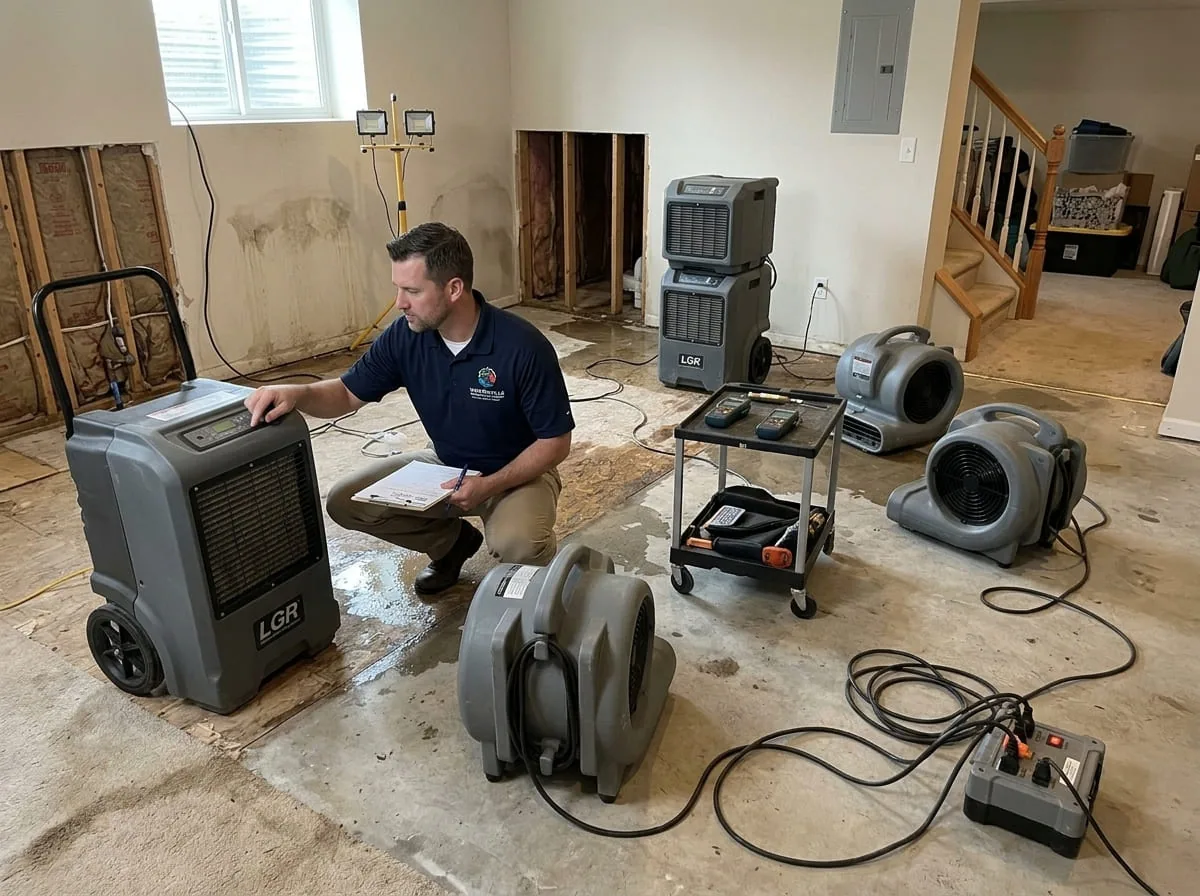
Drying isn't about the surface - it's about bringing moisture content in wood framing, subfloor, and wall cavities back down to a normal range, verified with a moisture meter rather than by touch or appearance. A wall can look and feel dry within hours while the stud behind it stays saturated for days. That's why professional drying involves daily moisture readings at multiple points, not a single check at the end.
The main factors that change the timeline
A handful of variables account for most of the difference between a fast dry-out and a slow one.
- Material type - hardwood and plaster hold and release moisture much more slowly than drywall or tile
- Water category - clean water dries faster than gray or black water, which often requires removing porous materials rather than drying them in place
- How long the water sat before extraction began - a few hours versus a few days makes a real difference
- Ambient humidity - Central Ohio's warm, humid summer stretch works against natural drying, while dry winter air (once the source is fixed) can help
- Airflow and equipment - commercial-grade air movers and dehumidifiers pull moisture out of materials far faster than open windows or a box fan
- Whether the space is enclosed, like a finished basement, where trapped humidity has nowhere to go without mechanical dehumidification
Why humid summers raise the stakes
In a typical Central Ohio summer, outdoor humidity is often too high to help dry an interior space - opening windows can actually slow drying rather than speed it up by adding moisture back into the air. That's one reason professional drying relies on dehumidifiers that pull moisture out of the air regardless of what's happening outside, and why the same water loss can take noticeably longer to dry in July than in a dry stretch of February.
Signs a space isn't actually dry yet
A musty smell, a slightly cool or clammy feeling in a wall, paint that bubbles or peels after the visible water is gone, and moisture readings above the material's dry standard are all signs that drying isn't finished. Restoration professionals typically continue running equipment and taking readings until several consecutive days confirm the material has returned to a stable, dry range - not just until the room looks fine.
Frequently Asked Questions
Can carpet and pad dry without being removed?
Sometimes, if the water was clean, the exposure was brief, and drying equipment is deployed quickly. Padding holds water like a sponge and is often the first thing that has to be removed, even when the carpet itself can be saved, because it dries far more slowly and can hold moisture against the subfloor.
Does drywall take longer to dry than wood flooring?
It depends on the specifics, but drywall generally dries faster than solid hardwood if it's caught early, because hardwood is dense and slow to release trapped moisture. Engineered flooring and the subfloor underneath can be the slowest part of the whole system to dry out.
What happens if drying equipment is removed too early?
Materials that seem dry on the surface can still hold enough moisture underneath to support mold growth within a couple of days, especially in a humid stretch. This is why professional drying is confirmed with moisture meter readings over several consecutive visits rather than by a single check.
Wondering If a Space Is Really Dry?
Restoration work is carried out by trained technicians using professional extraction and drying equipment, not guesswork.
Speak With a Restoration Team